ILOE Insurance VS Unemployment Insurance UAE
ILOE (Involuntary Loss of Employment) insurance is a mandatory scheme introduced by the UAE to provide financial protection to employees who lose their jobs unexpectedly. It acts as a safety net, offering temporary income support during periods of unemployment. Many people, however, search for “unemployment insurance in the UAE” expecting a traditional government welfare system, which creates confusion.
In reality, the UAE does not follow the global unemployment insurance model, instead, it has implemented ILOE as a structured alternative. This article will clearly explain the difference between ILOE and traditional unemployment insurance, including how each system works, its benefits, eligibility criteria, and what employees in the UAE should practically understand.
What Is ILOE Insurance in the UAE?
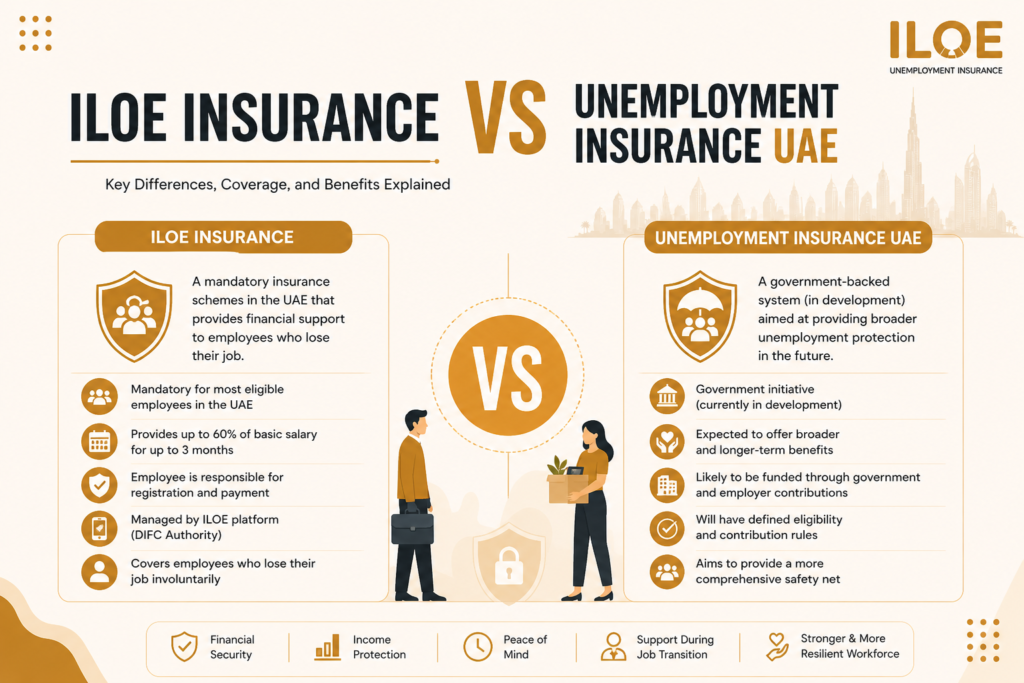
ILOE insurance, short for Involuntary Loss of Employment insurance, is a government-regulated scheme designed to support employees who lose their jobs due to reasons beyond their control. The main purpose of this system is to provide financial stability during the transition period between jobs, helping individuals manage essential expenses while searching for new employment opportunities.
Under this scheme, eligible employees can receive compensation of up to 60% of their basic salary for a limited number of months, depending on their salary category and compliance with the policy rules. One of the most important aspects of ILOE is that it is mandatory for most employees working in both the public and private sectors in the UAE.
The system works on a subscription basis, where employees pay a small monthly or annual premium. To claim benefits, individuals must meet specific conditions, including completing a minimum contribution period and proving that their job loss was involuntary, not due to resignation or disciplinary action.
What Is Unemployment Insurance in General?
Unemployment insurance is a widely used social protection system in many countries, designed to provide financial assistance to individuals who lose their jobs. It is typically part of a broader government welfare structure and is often funded through taxes collected from employers, employees, or both. In some countries, the government also contributes additional funding to support the system during economic downturns.
These programs usually offer more extensive support compared to ILOE, including longer benefit durations, job training programs, and sometimes additional allowances based on family or living conditions. The goal is not only to provide income but also to help individuals reintegrate into the workforce.
In the UAE, however, there is no traditional unemployment insurance system. Instead, ILOE serves as a more focused and controlled alternative. This distinction is important because many employees mistakenly expect broader benefits similar to those in other countries, which is not the case in the UAE.
Key Differences Between ILOE and Unemployment Insurance
Feature | ILOE Insurance (UAE) | Traditional Unemployment Insurance |
|---|---|---|
System Type | Mandatory scheme | Government welfare system |
Funding | Employee-paid premiums | Taxes or government funds |
Coverage | Limited (60% salary, capped) | Often broader benefits |
Eligibility | Employed individuals only | Citizens/residents (varies) |
Duration | Short-term (few months) | Can be longer-term |
Availability | UAE-specific | Common globally |
The UAE adopted the ILOE model to maintain a balance between employee protection and economic flexibility, ensuring support without creating long-term dependency on government resources.
Eligibility Criteria for ILOE Insurance
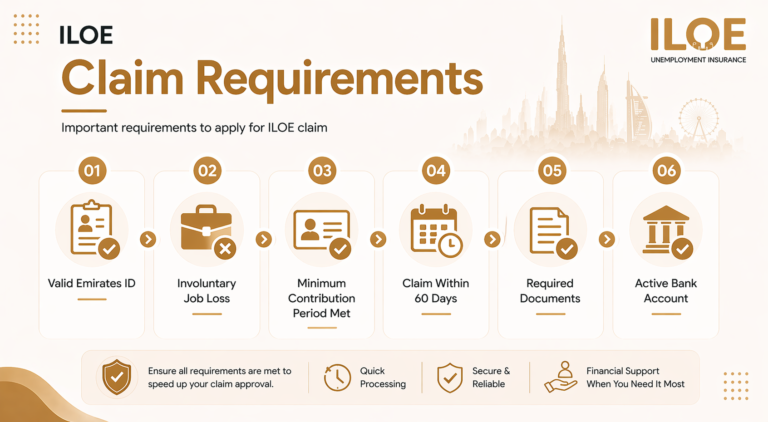
To qualify for ILOE insurance benefits in the UAE, employees must meet specific conditions set by the authorities. The scheme mainly covers individuals working in the private sector, federal government, and free zones, regardless of nationality. However, eligibility is not automatic, employees must fulfill certain requirements related to employment status, contribution period, and reason for job loss. Understanding these conditions is essential to avoid claim rejection or delays.
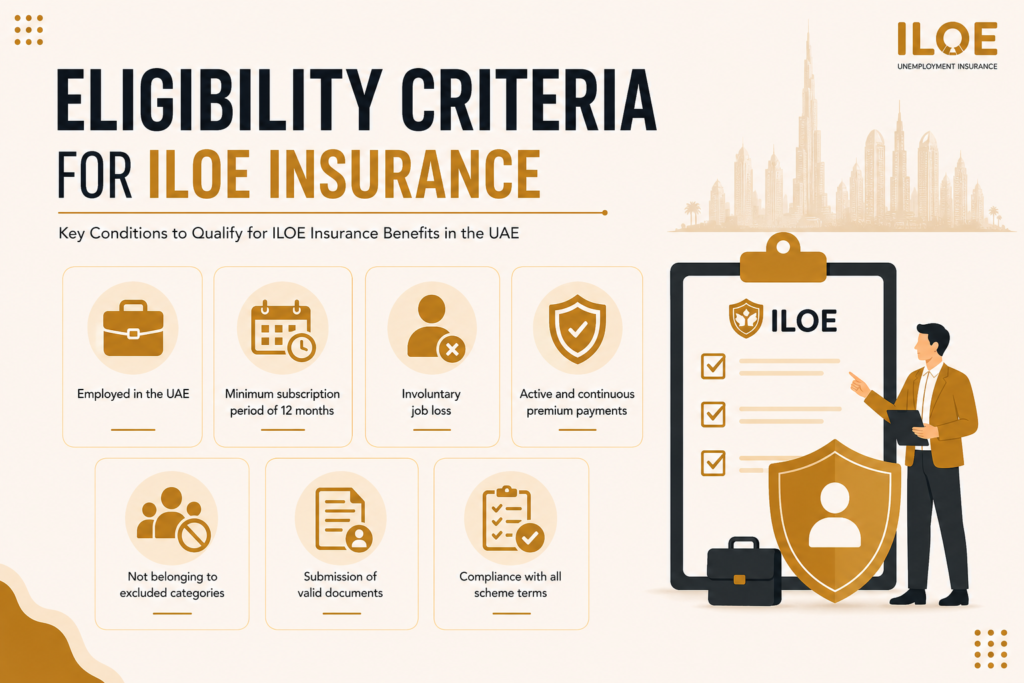
Meeting these requirements ensures smooth processing of claims and timely access to financial support.
Benefits of ILOE Insurance
ILOE insurance provides essential financial protection to employees in the UAE during periods of unexpected job loss. It is designed to offer temporary income support, reduce financial stress, and ensure individuals can manage their basic needs while searching for new employment. The system is simple, accessible, and particularly valuable in a fast-moving job market where stability is not always guaranteed.
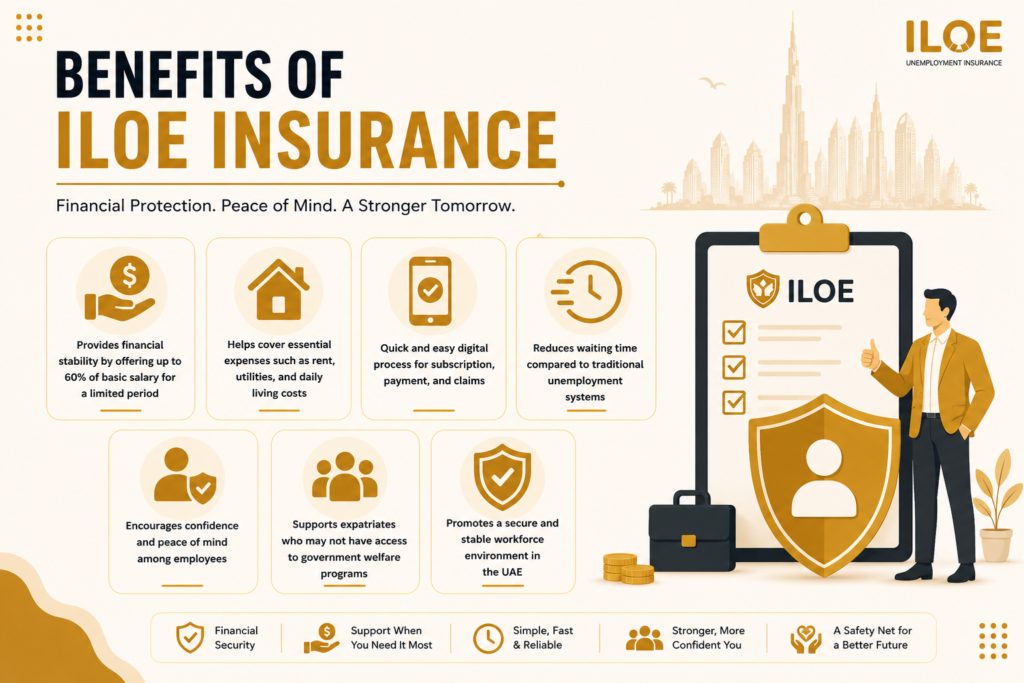
These benefits make ILOE a practical safety net for employees facing unexpected job transitions.
Limitations of ILOE Insurance
Despite its advantages, ILOE insurance has several limitations that employees should clearly understand. The scheme does not cover freelancers, investors, or domestic workers, which excludes a significant portion of the workforce.
Additionally, the compensation is limited both in duration and amount, with strict caps based on salary categories. This means it cannot fully replace a regular income for an extended period.
The claim process also comes with strict conditions, and not all job losses qualify for benefits. Continuous premium payments are required to remain eligible, and missing payments can lead to penalties or disqualification from claims
Which One Applies in the UAE?
In the UAE, the applicable system is ILOE insurance, not traditional unemployment insurance. Employees searching for “unemployment insurance UAE” are usually referring to ILOE, even if they are not aware of the correct terminology.
This distinction is important because expectations can differ significantly between the two systems. ILOE offers limited, short-term financial support rather than a comprehensive welfare program.
For employees, understanding this difference ensures proper compliance with the law and helps avoid fines. Subscribing to ILOE and maintaining regular payments is essential for staying protected and eligible for benefits.
Common Misunderstandings
Practical Example
Consider an employee in the UAE earning a basic salary of AED 10,000 who loses their job due to company restructuring. If they meet all eligibility conditions, they may receive around 60% of their salary, which is approximately AED 6,000 per month for a limited period.
This amount can help manage essential expenses temporarily, but it is not intended to fully replace long-term income. The example highlights how ILOE provides short-term financial relief rather than extensive support.
Frequently Asked Questions
Q2: Is ILOE mandatory for all employees?
Yes, it is mandatory for most employees, with specific exemptions.
Q3: How much compensation does ILOE provide?
Up to 60% of basic salary, subject to defined limits.
Q4: Can freelancers apply for ILOE?
No, only formally employed individuals are eligible under the scheme.
Conclusion
ILOE insurance and traditional unemployment insurance share the same goal of supporting individuals during job loss, but they operate in very different ways. The UAE’s ILOE system is a structured, mandatory scheme that offers limited, short-term financial assistance, unlike broader government-funded unemployment programs.
For employees in the UAE, understanding this difference is essential for setting realistic expectations and ensuring compliance with legal requirements. Subscribing to ILOE and maintaining regular payments not only helps avoid fines but also provides a valuable safety net during uncertain times. Staying informed and proactive is the key to making the most of this system.